What SpaceX’s Wireless Plan Gets Right, and the 80% It Leaves Out
Direct-to-cell satellites extend coverage to remote areas, but 80% of mobile data use happens indoors, where signals from space can struggle.
SpaceX is entering the US wireless market. After acquiring 65Mhz of spectrum, the company says it will pair its satellite network with distributed wireless infrastructure on Earth.
Sound familiar?
As Fierce Network recently reported, SpaceX is planning a terrestrial network of small cellular base stations installed at homes and businesses, alongside existing Starlink dishes. Starlink could provide backhaul to those sites, while satellites extend coverage beyond them.
Satellite connectivity, specifically direct-to-cell, is the most efficient answer wireless has ever had for places where macro towers were never economical or viable, like rural areas, shipping and trucking routes, and oceans. Satellite brings a new network type to the wireless ecosystem, working alongside macro towers, not necessarily replacing them.
But the reality is that indoor connectivity, where those macro towers fall short, isn’t completely solved by satellites either. About 70-80% of mobile traffic lives indoors and satellite operators have been clear about this limitation. Most service disclaimers note “outdoors with a clear view of the sky” or that coverage “may not be available inside buildings.”
Think about a hospital during a mass-casualty event. Emergency rooms, ICUs, and imaging suites sit behind steel, concrete, and shielded walls. No satellite constellation reaches a physician pulling up a patient's chart three floors down, no matter how many are in orbit. That gap has never been a space problem. It's a building problem, and it gets solved from inside the building.
That's the layer satellites were never built to reach, and it's exactly where Wi-Fi offload and distributed indoor infrastructure with Helium take over.
Satellite is reaching more places than ever, but it’s not a silver bullet for quality service
Satellite has been a breakthrough in delivering coverage to remote zones, but rarely can it get through the front door. Most mobile data is consumed in airports, arenas, conference centers, campuses, buildings, or other dense commercial areas.
So, indoor coverage has to confront:
(1) Congestion that erodes service. In other words, lots of people trying to get signal at the same time; and
(2) Inaccessible or inadequate Wi-Fi networks.
The truth is, there’s no single type of network that solves all wireless connectivity. The carrier playbook is shifting from who builds and owns the biggest network to who can intelligently and efficiently use the best available network.
This is what Helium has brought to the industry.
Wi-Fi offload through Helium builds visibility into user experience
Wi-Fi is already everywhere, especially inside the buildings where cellular networks often struggle most. The problem is that carriers couldn't trust it, because from their point of view, it was a black box. Historically, carriers had no controls to optimize subscribers' experience on indoor Wi-Fi and no way to enforce a standard for quality of service.
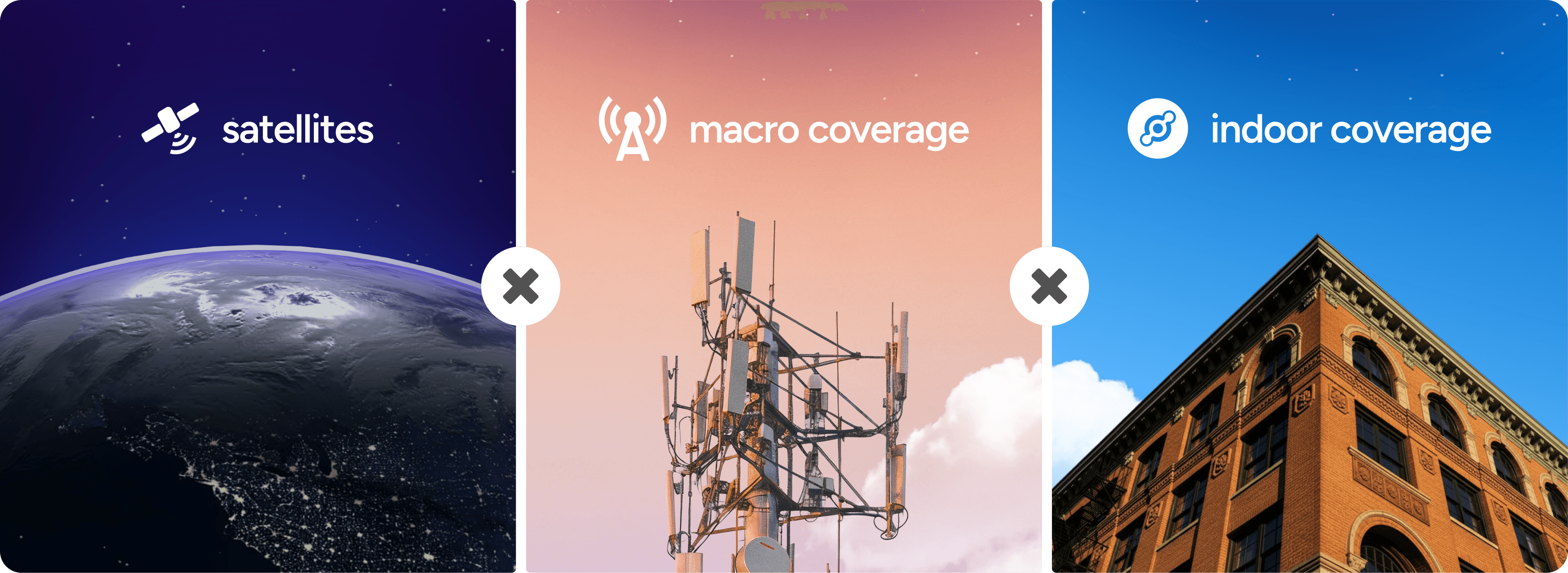
Enter Helium, which built the tools to ensure seamless interoperability and quality of experience for mobile operators handing off their subscribers, whether from satellites in the sky, macro towers on the ground, or Wi-Fi networks indoors.
Interoperability |
Helium poised to work hand in hand with satellite operators
Carriers that once relied solely on macro towers to deliver coverage are now routing subscribers onto Helium's decentralized Wi-Fi Network. Helium can do the same for a satellite-first carrier.
The Helium Network produces more than 50 million quality of service (QoS) metrics every day across tens of thousands of Helium sites, which give any operator (spectrum or satellite- based) the indoor visibility and control they need to trust complementary Wi-Fi networks. Integrated standards like Passpoint make the connections automatic and secure.
The same architecture that’s already carrying millions of users for MNOs and MVNOs on Helium today can extend to satellite. Whether a subscriber arrives from a macro network or from orbit, the indoor handoff lands on infrastructure carriers can trust and is already deployed, or as SpaceX President and COO Gwynne Shotwell put it, “as you need it.”
For most of wireless history, scale came from owning more infrastructure. The next generation will achieve scale by making more infrastructure usable. SpaceX is moving in that direction.
With the Helium model already built, validated, and growing, satellite’s formal arrival only hardens the decentralized approach and the need for better visibility, control, and seamless handoffs between networks.
For now, we say keep the extra-terrestrial developments coming and Helium is ready to take you inside.
To learn more, reach out to business@helium.com.