Fat Tuesday, Thin Signal? Not This Year
Helium’s New Orleans footprint absorbed a 550% Fat Tuesday surge, with more than 100,000 daily unique subscribers sustained for Carnival Weekend.
Tens of thousands of visitors filled New Orleans this week, streaming parades, posting videos from Bourbon Street balconies, refreshing ride-share apps, and checking parade routes in real time.
When traffic compresses this quickly, carrier networks feel it.
Helium’s New Orleans footprint felt it too. And the data shows exactly how.
Establishing the Baseline
Months before 2026’s Mardi Gras celebrations, deployers Josh Heller and David Key of LongFi rolled out a massive Helium-powered Wi-Fi infrastructure project in the French Quarter.
That groundwork set the stage for what the data revealed once Carnival began.
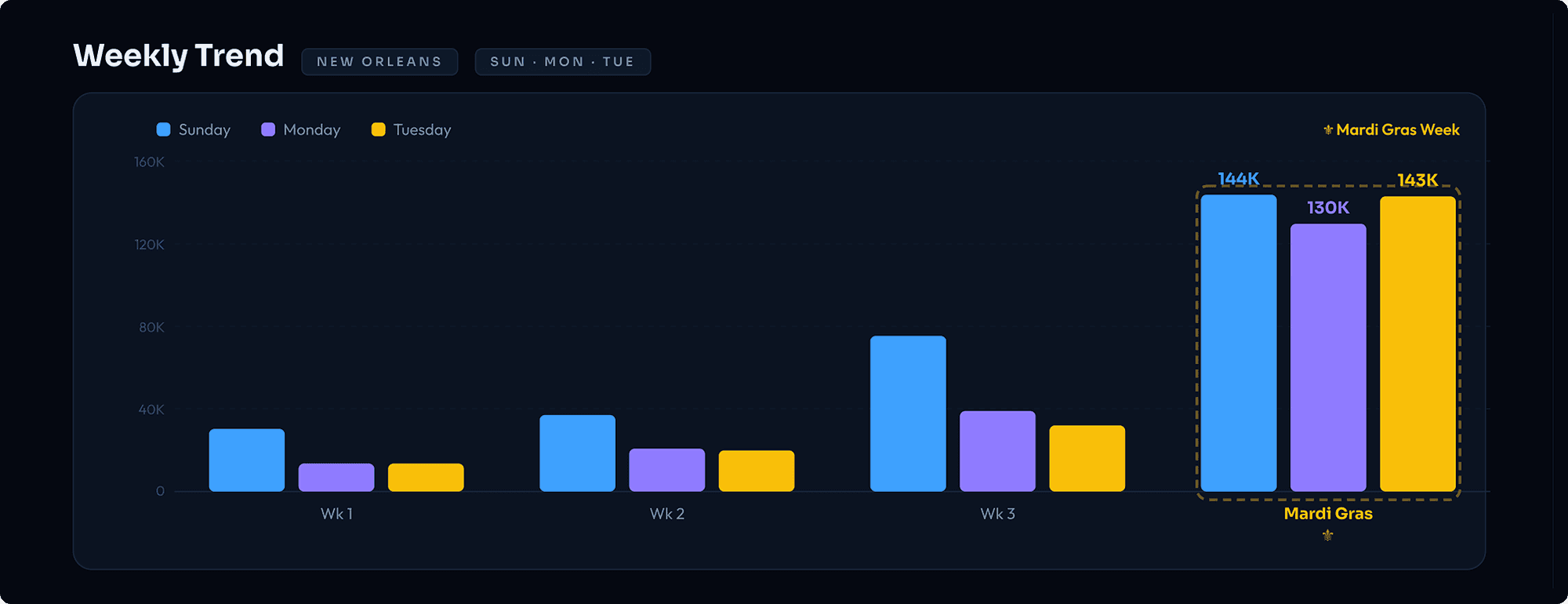
In a typical week, traffic follows a pattern: Across the three Sundays leading up to Mardi Gras, Helium’s New Orleans network averaged 48,000 unique subscribers. Mondays averaged 24,000. Tuesdays averaged just 22,000.
Here’s what happened once Carnival week began to build.
The Four-Week Surge
Comparing Sun–Mon–Tue across four consecutive weeks reveals the event’s impact.
During Mardi Gras week, Sunday reached 144,000 unique subscribers, compared to a typical Sunday average of 48,000. Nearly three times higher.
Monday (known locally as Lundi Gras) surged to 130,000 unique subscribers. That’s more than a 430% uplift over the prior three-week average.
Fat Tuesday transformed a normally quiet weekday into a peak-level traffic day, reaching 143,000 unique subscribers. That’s more than a 550% increase over the average Tuesday baseline.
What is typically one of the lightest days of the week became one of the heaviest.
The Daily Buildup
Zooming in on the final stretch shows how quickly demand accelerated.
By the start of Mardi Gras week, daily unique subscribers were already climbing. By Sunday, daily unique subscribers had surged into six figures and stayed there through Fat Tuesday.
On Ash Wednesday, traffic fell by more than 50% overnight, a sharp reset that underscored just how event-driven the spike had been.
The surge was not gradual organic growth. It was event-driven compression, building rapidly and releasing just as quickly.
What Made It Work
Much of this New Orleans coverage is powered by LongFi, a Helium deployer with a concentrated footprint across the French Quarter and surrounding hospitality corridors.
In the weeks leading up to peak season, the team expanded coverage along major parade routes and high-traffic hospitality blocks, ensuring the network could handle sudden density spikes.
As visitor density increased, the network absorbed the load.
For users, the experience remained seamless. For hospitality partners, connectivity held during one of the highest-pressure weeks of the year.
“Historically during Mardi Gras, you just can’t connect,” says David Key of LongFi. “Calls fail. Texts stall. Data doesn’t load. This year, people are already seeing something different.”
What It Means
Large-scale events compress weeks of network demand into days.
Mardi Gras week in New Orleans demonstrates how decentralized infrastructure scales under pressure. Carrier traffic can be offloaded onto community-deployed Hotspots, preserving continuity in the moments when demand spikes most.
More traffic also means more Data Credits consumed, more HNT burned, and more rewards flowing to deployers who built the coverage in advance.
From late January to Fat Tuesday, Helium’s New Orleans network didn’t just handle growth.
It absorbed a five-fold surge and sustained more than 100,000 daily unique subscribers through the city’s biggest week of the year.
To learn more about Helium, visit world.helium.com and email business@helium.com.