Faster connectivity for Fast Food Restaurants
How 34 national brands are meeting the demand for high-quality connectivity on the Helium Network.
Fast food has become one of the most connected industries in retail: Quick-service and chain restaurants rely on apps and connected customers to run loyalty programs, deploy incentives, and keep customers coming back for seconds. Helium Network data shows what that shift looks like in practice, and how national chains can close the coverage gap without breaking the bank.
Why Franchises and Chain Restaurants Need Wi-Fi Offload
The modern fast food order starts on a phone. Customers browse the menu in an app, claim the app-only deal, pay through a loyalty account, and pull up a QR code at the counter. Chains spent the past decade engineering this shift because digital orders are larger, faster to fulfill, and richer in customer data. The strategy worked. It also created a dependency that most locations were never built to support: every one of those transactions requires a fast and responsive internet connection inside the restaurant.
That is harder than it sounds. Over the course of a lunch rush, a quick-service restaurant cycles a steady stream of connected devices through a few thousand square feet, often in an area where the nearest cell tower is also serving a highway, a shopping center, and a dozen drive-thrus at once. Macro networks were designed for broad coverage, not for indoor demand that spikes twice a day in the same buildings. When the network chokes, the app spins, the order stalls, and the line backs up. For a business model built on throughput, weak indoor connectivity cuts straight into revenue.
This is where Helium Carrier Offload comes in: Helium routes mobile traffic from congested cellular networks onto local wireless coverage inside the venue. And on the Helium Network, the fast food industry is already demonstrating what that looks like at national scale.
The restaurant footprint, by the numbers
The Helium Network now includes coverage at 34 national restaurant chains, spanning nearly 2,500 deployment sites across the United States. In a single month, those sites offloaded more than 274,000 GB of mobile data. The roster reads like a beloved mall food court: Taco Bell, KFC, McDonald's, Starbucks, Chick-fil-A, Sonic, Dunkin', Chipotle, Wendy's, and dozens more.
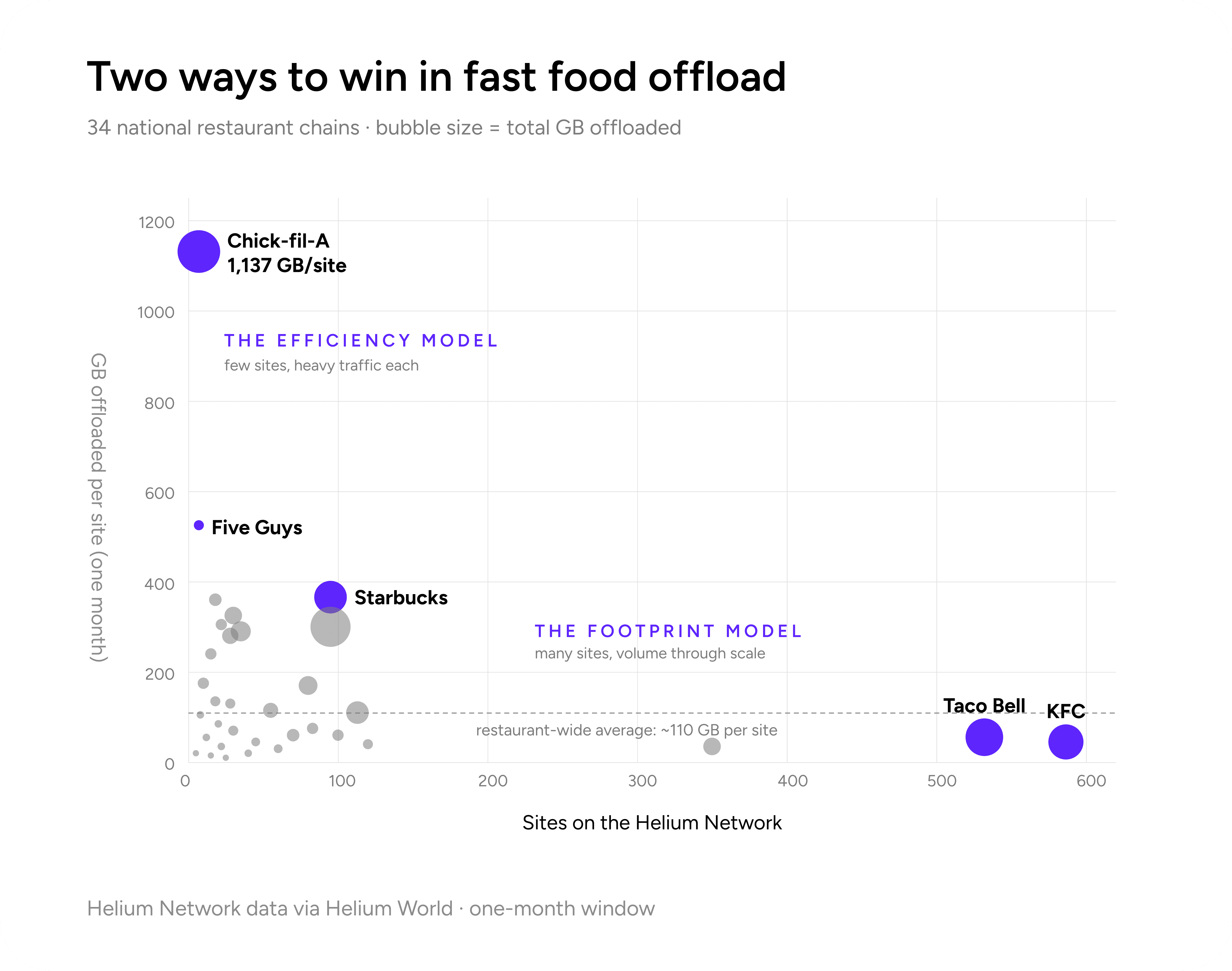
Two patterns stand out in the data, and they point to two different ways a deployment can succeed.
The efficiency model
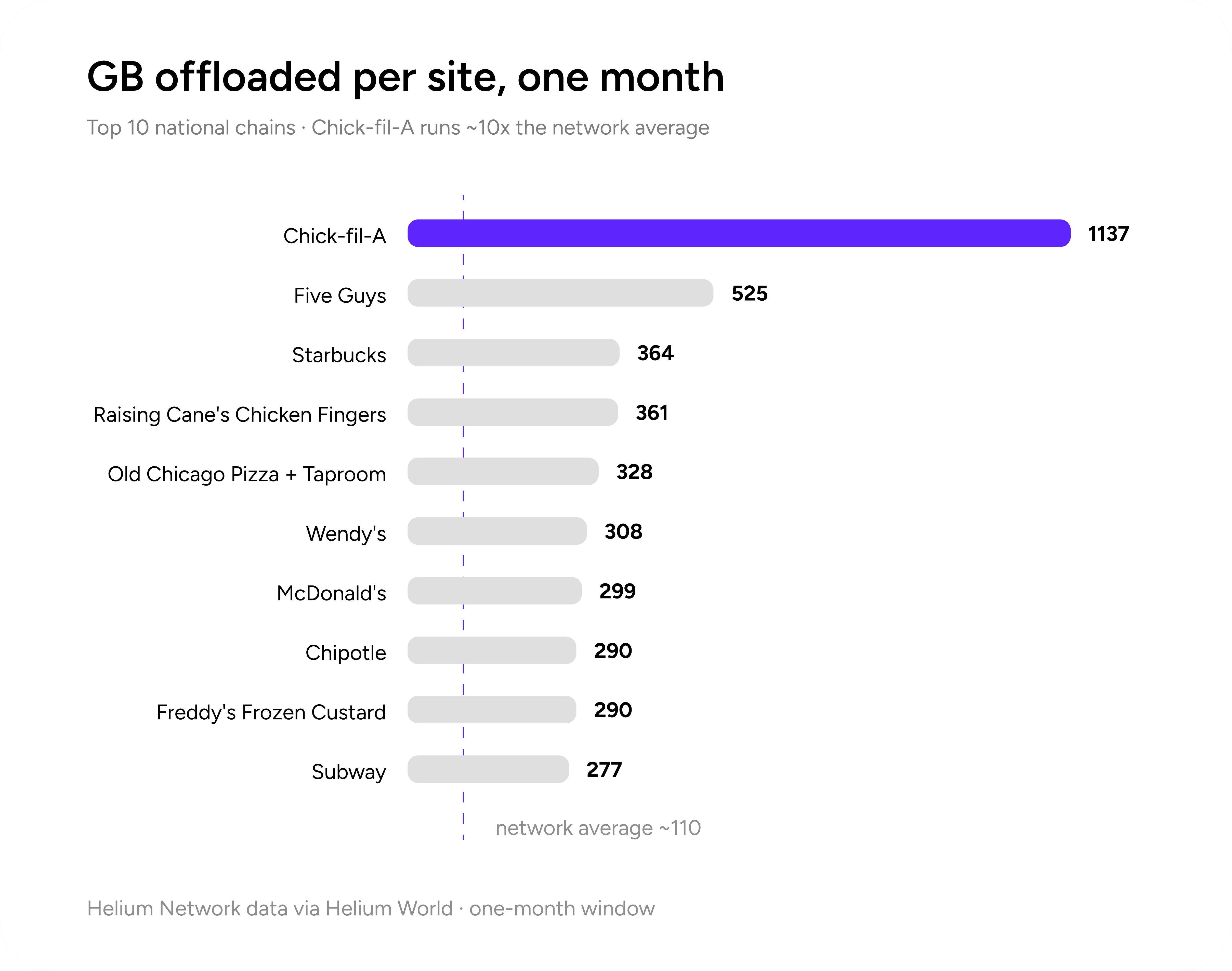
There are only 34 Chick-fil-A locations on the network, but they lead every other chain in total traffic. Each site offloaded roughly 1,100 GB over the month, about 38 GB every day, and roughly ten times the restaurant-wide average. Taken together, Chick-fil-A's monthly total works out to the equivalent of streaming around 6,400 movies in HD.The explanation is not mysterious. Chick-fil-A runs some of the busiest per-store volumes in the industry, and busy stores full of app-ordering customers generate offload demand to match.
Smaller footprints show the same effect. Five Guys has six locations on the network, but each one averages 525 GB for the month. Raising Cane's shows seven locations at 361 GB apiece. A single well-placed deployment in a high-traffic restaurant can carry meaningful traffic on its own.
The footprint model
At the other end of the spectrum, KFC and Taco Bell have the two largest deployments in the dataset, at 586 and 539 locations respectively. Scale compounds: a portfolio of ordinary locations, aggregated, produces traffic volumes that rival the busiest single-brand deployments.
Category patterns reinforce the point. Coffee shops, where customers linger, average around 218 GB per site for the month, roughly double the quick-service average, where the business model discourages dwell time. Starbucks alone moved 32,774 GB across 90 locations.
What this means for quick-serve restaurants
For franchise operators and the people who manage their networks, the appeal is practical. Offload coverage works alongside the connectivity a restaurant already has, and it addresses the problems that now sit closest to revenue, like mobile orders that complete on the first try, loyalty apps that load at the counter, and payment systems that do not stall during the rush. Helium offers restaurants a cashflow positive path to the connectivity they need to operate in 2026, without a construction project or a carrier contract negotiation.
The data suggests the industry has noticed. Thirty-four national chains did not end up on the same network by coincidence. Fast food went digital years ago; its connectivity is catching up now, one location at a time.
Get started
Do you have access to a fast food restaurant's wireless network?