Back to school and back online
With thousands of new education expansion zones going live, more campuses are primed and ready to do the same.
Every campus absorbs that back-to-school spike in August. Summer ends, students arrive en masse, and the network strain is obvious on day one. On most campuses the surge lands on cell towers that were already struggling to push signal through concrete, steel, and modern glass, which is why coverage that looks fine on a map disappears the moment someone walks into a lecture hall.
The State Of Coverage for K-12 Schools
More than 30 K-12 school systems across 17 states have now onboarded networks with Helium, and the newest ones are lighting up in step with the school calendar.
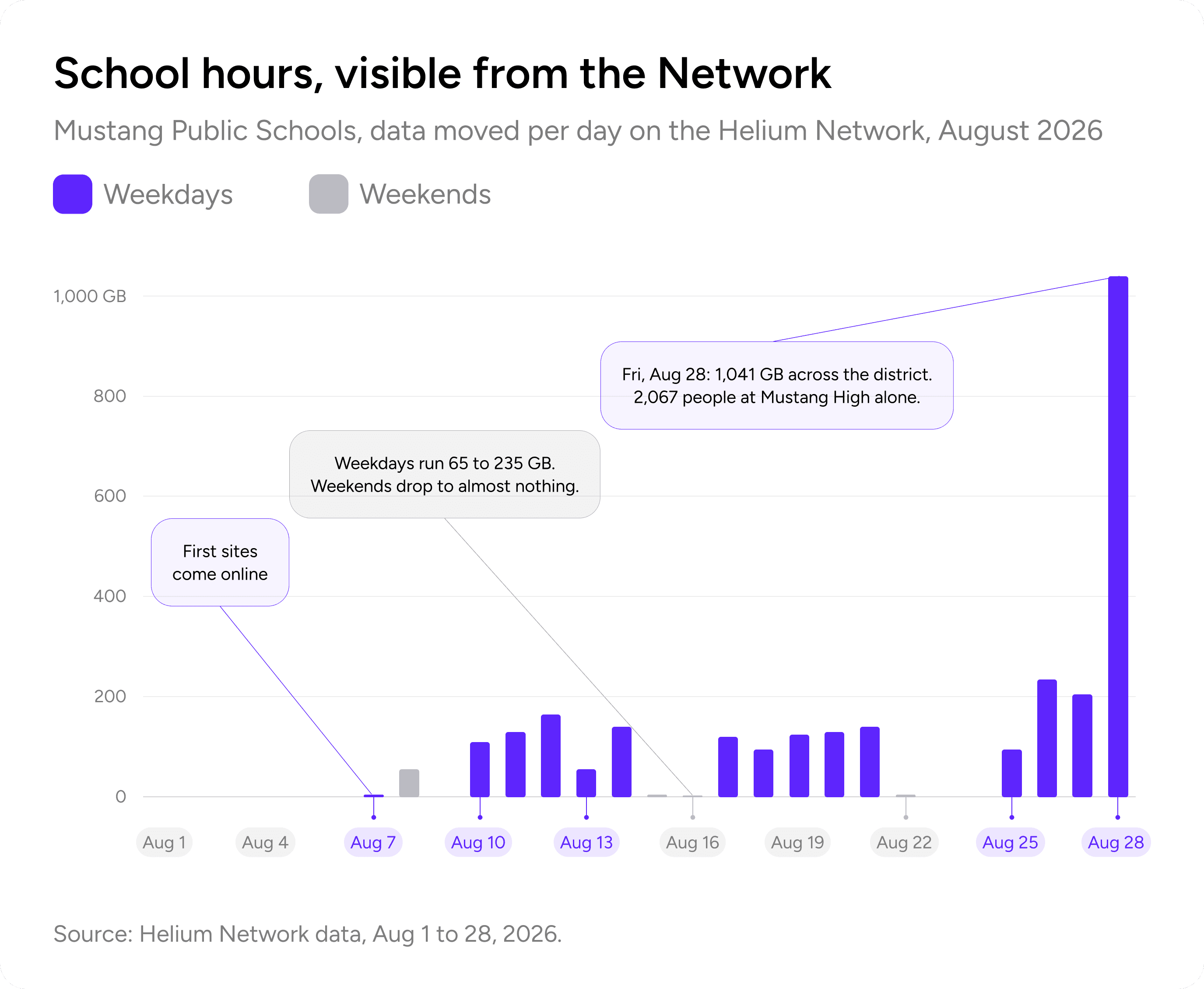
Mustang Public Schools, in the western Oklahoma City metro, brought 14 sites onto the Helium Network in the two weeks before classes started, including Mustang High School and the elementary schools. On Friday, August 28, the high school alone served 2,067 people and moved 636 GB, its biggest day on the network yet.
Mustang's sites went from zero traffic at the beginning of August to more than 3.4 TB across roughly 65,000 sessions by month's end. The traffic keeps school hours: weekdays run between 65 and 240 GB, and most weekend days drop to a few GB.
In California, Folsom Cordova Unified came online over the summer and more than quintupled its July volume in August.
A school district is public infrastructure, and this is the same playbook Celina, Texas is running citywide. America's fastest-growing city turned Wi-Fi it already owned, at the public library, the senior center, and downtown, into carrier coverage that now moves about 100 GB a day. A district's network is often the largest publicly owned network in town, and like Celina's, it was bought and paid for long before anyone thought of it as coverage. Behind the districts already live, more are onboarded and working toward activation now. Fontana Unified and Kern County schools in California came aboard this spring through the same deployer that built Mustang, new school agreements were added as recently as this month in Indiana and South Florida, and a longer roster has onboarded through partners, from Santee School District outside San Diego to Zapata County ISD in Texas to Newport News Public Schools in Virginia.
The Campus Footprint, By the Numbers
The Helium Network now includes coverage at more than 30 college and university venues across 14 states, Washington, DC, and Mexico. The roster runs from Morehouse College in Atlanta, where the Martin Luther King Jr. International Chapel is among the busiest education venues on the network, to Holmes Community College in Mississippi.
Campus demand keeps a unique schedule. In April, mid-semester, those venues moved 3.8 TB of mobile data across more than 270,000 connection sessions, averaging just under 3,800 users a day. In July, with students gone, the same venues averaged just under 2,000 users and moved 2.2 TB. Demand that doubles every September is exactly what a fixed construction project handles badly and a Wi-Fi network the school already owns handles for free.
What's Next For Education
For anyone weighing a campus deployment, the timing is unusually good. Helium just published over 5,000 new expansion zones covering universities, colleges, and K-12 schools across the country. An expansion zone marks an area where a carrier has told us it wants Helium coverage, and a deployment inside a published zone moves faster through the offload approval process than one outside it.
Zone in World.Helium | Location | Size |
College Station, TX | 22.5 km² | |
East Lansing, MI | 20.9 km² | |
Davis, CA | 15.6 km² | |
Lynchburg, VA | 13.6 km² | |
University of Alaska Fairbanks | Fairbanks, AK | 12.5 km² |
With the recent approval and passing of HIP 150, sites in expansion zones can apply for a higher reward multiplier. Anyone considering a campus build should read HIP 150 before deciding where to point their effort.
Want to bring Helium to a college campus near you? Email business@helium.com.