Hotels and Casinos Are Partnering with Helium To Get More Utility Out Of Their Existing Wi-Fi Networks
The Hospitality industry spent two decades building robust Wi-Fi coverage. Now carriers need that coverage, and 30 days of Helium Network data show its value.
Hotels run enterprise-grade Wi-Fi for a simple reason: guests demand reliable connectivity, the kind of connectivity carriers can’t provide indoors. Cellular signal weakens at the building exterior, and concrete floors, coated glass, and rooms far from the nearest cell tower make it worse. So hotels built and paid for their own coverage, justified it on guest satisfaction, and treated it as a cost of doing business.
That is starting to change. Data from 243 hospitality properties actively offloading on the Helium Network shows a consistent pattern: the properties moving the most mobile data are the ones where guests stay longest and where the surrounding cellular network is weakest.
Carriers Need What Hotels Already Have
The indoor coverage problem hotels solved for themselves is the one carriers still can't. No carrier can justify building tower capacity for the inside of every hotel in America, and the cost of traditional in-building systems like distributed antenna systems (DAS) can be difficult for all but the largest properties to absorb. Yet nearly every hotel already runs what carriers need: a wireless network built for density, sized for full occupancy, and designed to reach every room.
Carrier offload is how cellular providers solve this connectivity problem. When a cellular network is congested or out of range, major carriers route mobile traffic onto local wireless coverage instead. Through the Helium Network, a hotel's existing Wi-Fi can carry that traffic, and carriers pay for the capacity. The signal hotels built as an amenity is the signal carriers now need, and there is finally a direct way to supply it.
Offload is invisible to the guest. It happens automatically, with no captive portal, no login screen, and no password, so it serves every device on the property, including the many guests who never join hotel Wi-Fi.
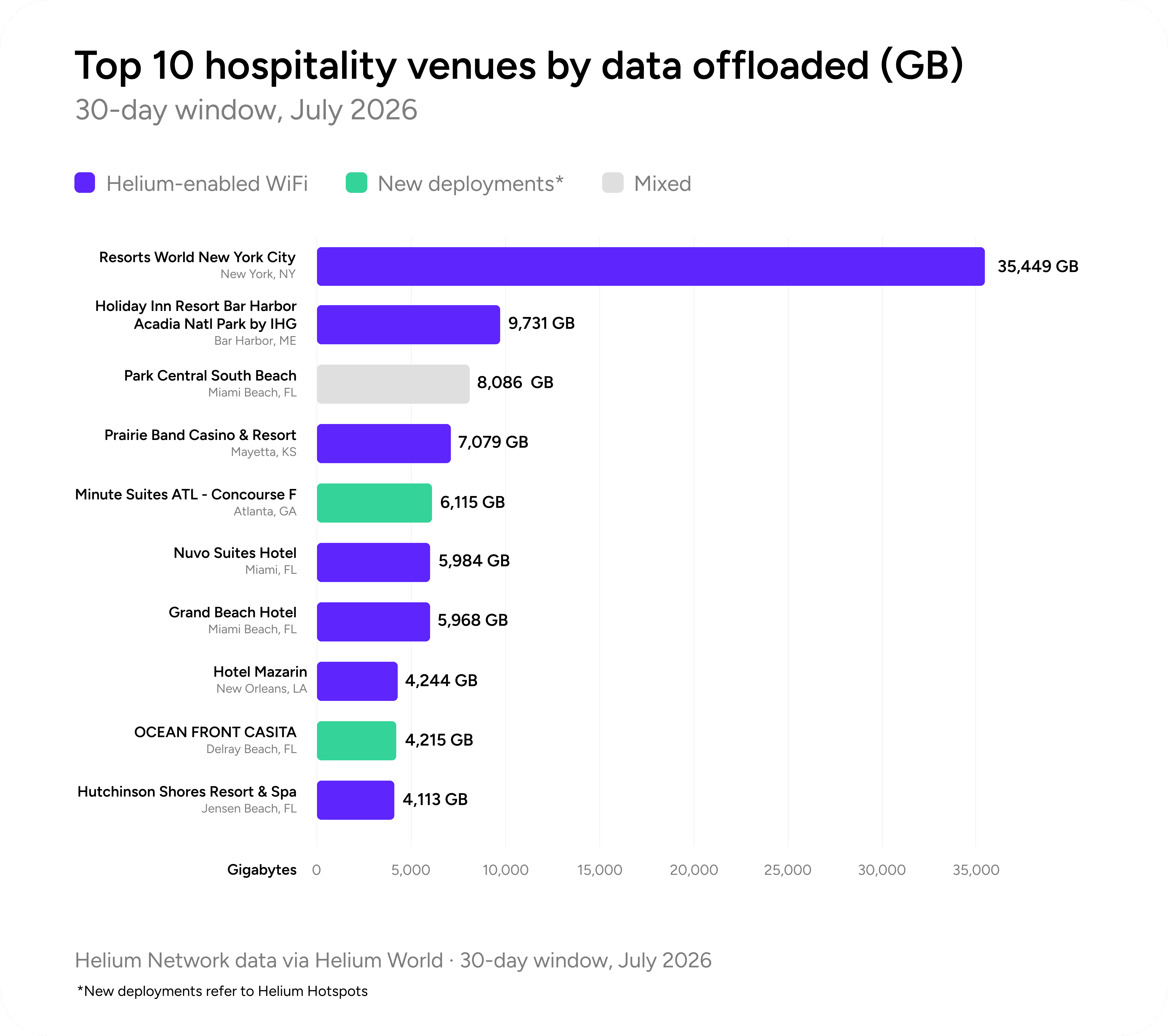
Bringing a property onto the network is largely a software step: through Helium Plus, a hotel's existing access points are enabled for offload with no new hardware. The data bears this out. Eight of the ten highest-throughput hospitality properties in this 30-day window are conversions of equipment the properties already owned.
The Footprint, By The Numbers
Hospitality is already one of the largest venue categories on the network. Over a single 30-day window, 243 hotels, resorts, casinos, motels, inns and other lodging properties handled 15,174,689 connection sessions and offloaded 211,547 GB of mobile data, nearly 212 terabytes. The properties range from full-service flagships in Manhattan and Chicago to beachfront hotels in Miami Beach, airport hotels in Atlanta and SeaTac, and roadside inns across the Dakotas.
What a full-property conversion looks like
Bar Harbor, Maine, the gateway to Acadia National Park, has famously strained coverage in summer. There, the Holiday Inn Resort enabled 81 existing access points for Helium coverage. The Days Inn next door adds about 15 more.
Together, the two turned one stretch of Eden Street into one of the busiest hospitality corridors on the network during peak season, offloading nearly 12,000 GB in the 30-day window. No trenching, no towers, no construction. The equipment was already installed.
Casinos and resorts push the pattern to its limit
If hotels show that hours indoors drive offload, casinos and resorts are the extreme case. Guests don't just sleep there; they spend whole days on the property, and the networks were sized for it.
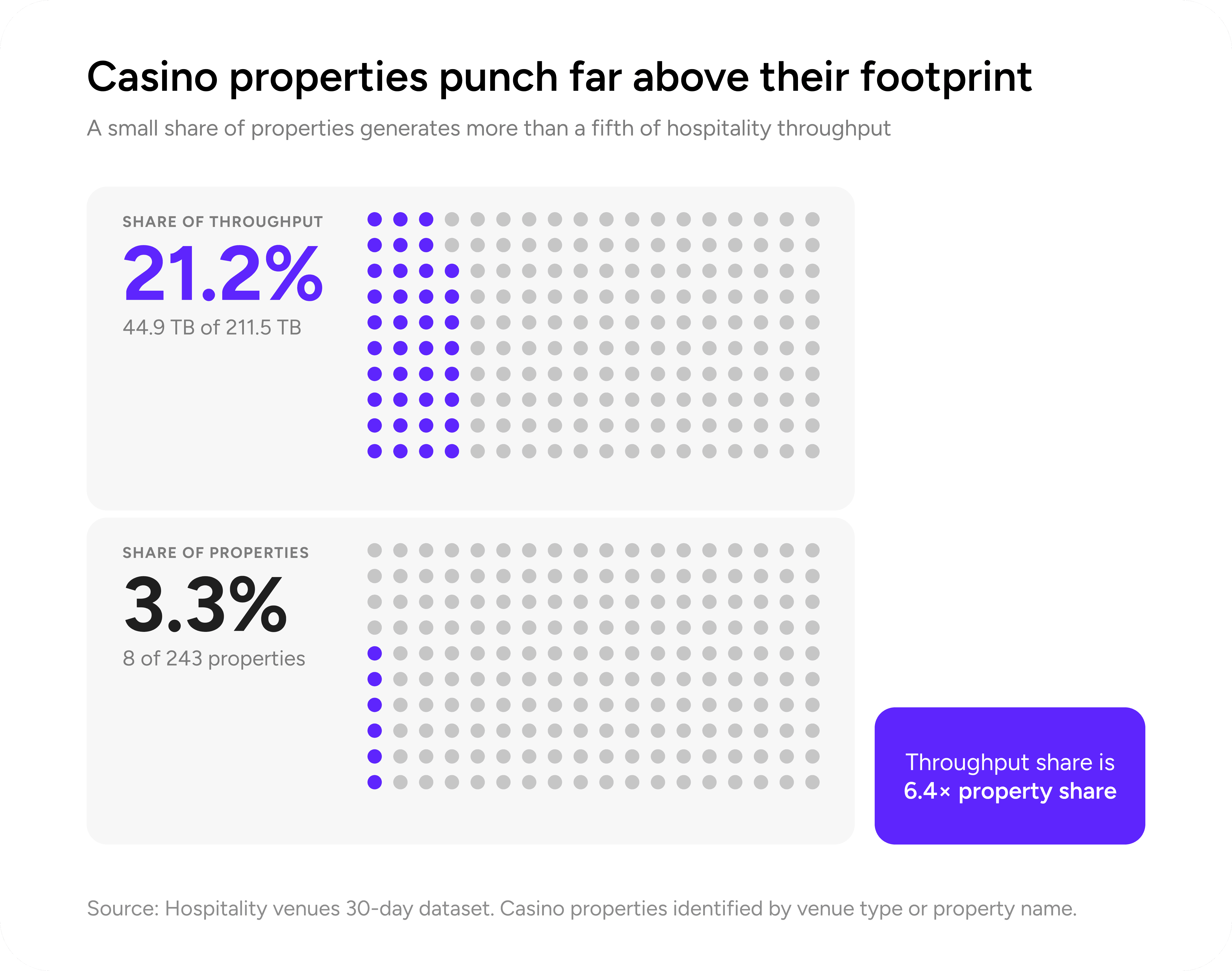
The concentration is striking. Casino properties generated more than a fifth of all hospitality traffic from about three percent of the venues.
The busiest is Resorts World New York City in Queens, offloading the equivalent of streaming roughly 6,000 movies in HD. Prairie Band Casino & Resort in Kansas posted nearly 784,000 sessions. Hutchinson Shores Resort & Spa on Florida's Treasure Coast logged 480,000 sessions and over 4,100 GB.
A side hustle for an asset hotels already own
None of this asks hoteliers to buy anything. The network already exists, justified years ago on guest experience, and that remains its first job: streaming that works in every room, mobile keys that open on the first tap, a signal that holds up at full occupancy.
Offload gives the same network a second job, absorbing the indoor mobile demand carriers can't serve, without construction or a new draw on capital budgets.
Hospitality solved indoor connectivity for itself because no one else would. Nearly 212 terabytes in a month suggests that solution has become infrastructure the wider mobile ecosystem needs. The properties turning it on are simply the first to be paid for what their networks could already do.
Bring your hospitality properties onto the Helium Network today.