The Next Era of the Helium Network
From coverage solution to intelligent enablement platform. Helium's next chapter starts now.
Hello Helium community. My name is Mario Di Dio and today I’m honored and humbled to step in as CEO of Helium.
Amir Haleem dreamed up a better way to connect the world, spent a decade building it, and grew Helium into a Network that millions of people rely on every day. I’m grateful to Amir as he transitions to Chairman while I focus on executing a refreshed vision for Helium.
I’ve been at Helium for several years running the Network side of the business across carrier partnerships and Wi-Fi infrastructure. Before that, I spent all of my career in enterprise telecom. I came to Helium because I saw what this Network could become, and the opportunity is bigger than any of us expected.
On Tuesday, we shared that Andrew Yang’s Noble Mobile is acquiring the Helium Mobile Carrier, our consumer wireless carrier business. This is a milestone worth celebrating since Helium Mobile proved decentralized infrastructure was truly carrier-grade, and Noble Mobile is the right partner to carry that forward. Every Noble Mobile subscriber will now be able to connect through the Helium Network in addition to Noble’s 5G partner. For the deployers who power the Helium Network, carrier traffic now includes Noble, which continues to burn HNT. Your role as the infrastructure backbone of this Network isn’t just preserved, it’s still the foundation everything ahead is built on.
With this transition, our consumer brand goes to the right operator to serve those customers and Helium is entirely focused on its Network platform. Today, we’re publishing a governance proposal that charts the course for what comes next.
Press enter or click to view image in full size
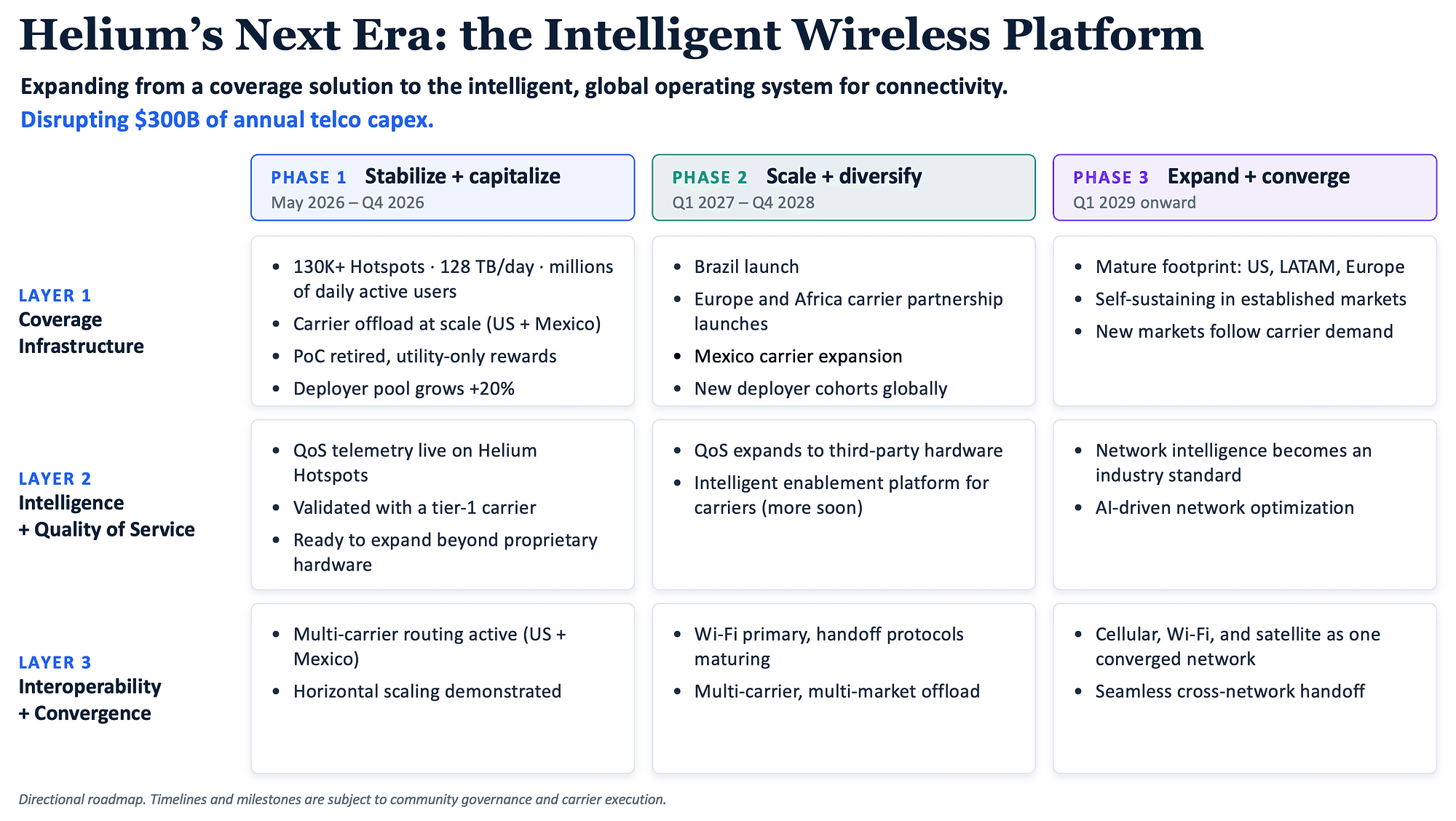
The global wireless industry spends over $300 billion a year building and maintaining network infrastructure. That number is facing cuts annually from large carriers, while every year brings more devices, more density, and more demand for high volume connectivity. Most of that demand falls in places that macro towers were never designed to reach: stadiums, transit hubs, hospitals, apartment buildings, along with entire communities the industry deems uneconomical. No single carrier can solve this alone and the capital model that built the last generation of wireless infrastructure cannot build the next one.
Helium solves the global gap in connectivity with an infrastructure layer built and operated by many people instead of a few corporations. What started as a coverage solution is now an intelligent enablement platform. Helium brings real-time quality-of-service intelligence, multi-network interoperability, and AI-driven analytics that no legacy vendor is incentivized to build. We bring carriers tools that never existed to be more efficient with how and where connectivity is delivered while consumers get better coverage and costs come down. It’s a remarkable thing.
We’ve flipped a century-old model to one where people deploy, operate, and get compensated for powering wireless infrastructure. We’ve built what the wireless industry can’t build for itself, and we’re just getting started on an opportunity that’s measured in hundreds of billions of dollars.
Press enter or click to view image in full size
Helium is operating at carrier scale today, millions of daily active users and hundreds of terabytes of carrier data routed daily. We have major carrier partnerships active in the United States and Mexico, with international expansion underway in Brazil and the UK. When hundreds of thousands of people hit New Orleans for Mardi Gras, the Network absorbed a 5x traffic surge because deployers had already built the coverage, and similarly for the Big Game in the Bay Area. The Helium Network is no longer trying to prove it belongs in the telco conversation. It is the conversation.
Every day, millions of people scroll, text, and call their loved ones through a people-powered Network most have never heard of. That’s exactly how connectivity is supposed to work: ubiquitously, reliably, at scale. Now, with Noble Mobile joining as a Network partner, alongside several other major carriers, we validate something even bigger. Helium goes beyond carrier offload to a platform that other wireless services can build on.
Carriers need dense, affordable, intelligent coverage and Helium delivers it at a fraction of the cost with real-time intelligence and interoperability that no legacy vendor offers. This isn’t an incremental improvement, it’s an entirely new infrastructure model that scales horizontally across every carrier and market in the world.
Press enter or click to view image in full size
Press enter or click to view image in full size
This is the telco industry’s AWS moment. When enterprises couldn’t justify building and maintaining their own data centers, Amazon built AWS and converted fixed capital expenditure into variable, usage-based infrastructure. The same structural shift is happening in wireless, and Helium is positioned at the center of it.
Building infrastructure at this scale requires resources. Every serious infrastructure network faces a moment where demand outpaces deployment. The question is how the protocol funds the next wave of growth while keeping incentives aligned with the community that builds it.
Today, we’re proposing Helium’s version of that. HNT is a network utility token. It’s earned by deployers who carry real carrier traffic, burned by carriers who use the Network, and governed by the community that builds it. The proposal we’re publishing today introduces new transparency and accountability mechanisms alongside a resourcing plan that go beyond what most infrastructure platforms offer.
Helium’s economic model was designed for a world where carrier adoption happened faster than it did. Now that we have real data on how carriers actually adopt, we can fix the model to match reality. This is an informed correction on an opportunity that isn’t a niche. Carrier capex is declining globally while 5G densification demands and early 6G planning require more infrastructure in more places than ever. A trillion-dollar industry is actively searching for a new model that we’re already delivering.
Press enter or click to view image in full size

The economic model underneath the Network hasn’t kept pace with it. The $0.50/GB target earn rate has compressed to roughly $0.10/GB as traffic grew 4x while HNT issuance stayed fixed and the dollar-equivalent value of deployer compensation declined with broader market conditions. Proof-of-Coverage (PoC) still pays Hotspots for existing rather than for being useful. Today’s proposal fixes all of it.
Here are the key points of the proposal, but I encourage you to read it in its entirety:
Utility replaces Proof-of-Coverage. Hotspots earn when they carry real carrier traffic. No more rewards just for being plugged in. We’re restructuring how emissions are distributed so a larger share goes directly to the deployers who are actually serving the Network’s users. This applies across both Mobile and IoT: if your Hotspot is useful, you earn more.
A deployer earnings floor tied to real carrier revenue. It’s important to be honest about what this means. The Network has historically subsidized deployer payouts at the protocol rate of $.50, versus the commercial rate carriers actually pay. That subsidy isn’t sustainable and this proposal phases it out. Ahead of the vote, we’re resetting the carrier-paid rate to reflect what carriers actually pay today. The new deployer floor and the larger data pool are the cushion built to soften that reset. The floor we’re introducing is anchored to real carrier revenue, not subsidized rates. It’s an honest adjustment and a short-term one. It matters because the floor moves with the market. As carrier revenue grows and rates improve, the floor rises with it. It also removes a ceiling by untethering deployers from the $.50/GB rate. The foundation is real economics, not artificial support, and it’s designed to improve with Network growth.
Operations and network growth. Every infrastructure company faces a moment where demand outpaces deployment capacity. Our proposal is a structured HNT mint into a publicly visible on-chain vault that tapers over time and funds what the Network’s growth demands: international carrier expansion, deployer incentive programs, and the intelligent connectivity platform carriers are already asking for. Every outflow is observable and the community can terminate it at any time.
Advisory Council. A new governance body of 7 seats, 5 community-elected, with real visibility into how network resources are allocated. Monthly and quarterly disclosures, everything on-chain, and direct engagement with the Helium core team on strategy, spending, and Network priorities. This is a level of transparency and community governance that reflects how decentralized networks should operate.
The full proposal details the mechanics, timeline, and implementation. Please read it. Challenge every assumption and ask the hard questions.
Press enter or click to view image in full size
We expect the questions to come fast so we’ll be available for the first wave of questions today at 3pm ET. Once everyone has had time to fully digest the proposal, we’ll host a second Q&A next week with others to follow. We’ll also be in Discord throughout the deliberation period, answering questions and engaging directly.
HNT holders govern this decision. You participate in the Network that millions of people connect through every day, and this proposal determines how that network rewards the people who build and maintain it. The proposal we’re publishing today resources the next phase.
To the deployers who showed up before there were millions connecting. To the carriers who took a chance. To the Helium Mobile subscribers who proved the thesis with every call and every scroll. Thank you.
I came to Helium because I believe this is the most important infrastructure project being built right now. I’m asking you to read this proposal, engage with it seriously, and help us get it right.
Let’s build what comes next, together.
Read the full proposal
Review the abridged proposal explainer
Join the conversation on Discord