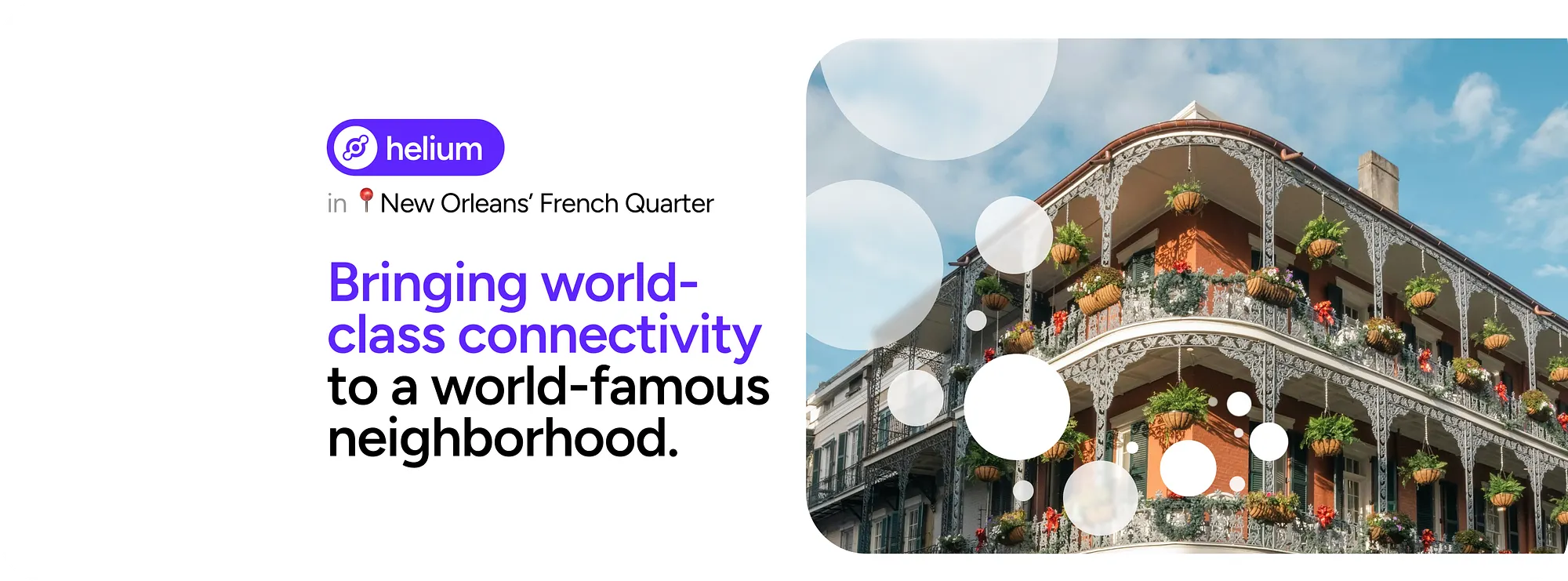
Bringing better connectivity to New Orleans’ Historic French Quarter
Two deployers take on the challenge of bringing world-class connectivity to the world-famous neighborhood.
New Orleans’ French Quarter is a living, breathing cultural landmark. For locals, it’s sacred ground, and for the people who protect and preserve it, every change is scrutinized with care. So when David Key and Josh Heller of LongFi Solutions began the work to improve connectivity in the neighborhood, they knew that doing it right meant doing it invisibly, without altering the district’s character.
Key, a native of New Orleans, had this to say about the connectivity issues facing the French Quarter: “Ask anyone in New Orleans about cell service in the Quarter, and you’ll get the same answer: it’s unpredictable on a good day, and nearly unusable during major events.”
The Quarter draws millions of people every year for major events like Mardi Gras, Halloween, Red Dress Run, and Decadence. The uptick puts a huge strain on network bandwidth, as visitors, businesses, and first responders all compete for the same limited capacity. Even on an ordinary Saturday night, download speeds dip and calls struggle to connect.
Everyone in the district has a story about it: payments that won’t go through unless you bring the card reader outside; a parking app that wouldn’t load (and a car getting booted as a result); rideshare requests that time out; or a call to a friend, family member, or the police getting dropped.
The Helium Approach
Key and Heller reasoned that the solution to the French Quarter’s connectivity problem had to be culturally sensitive and subtle.
“You can’t just put a cell tower in the middle of a historic district,” Key said.
Heller had successfully been doing this kind of work earlier this year, bringing decentralized wireless networks to UNESCO World Heritage sites in Oaxaca, Mexico. Their goal was simple: improve the experience for every tourist, local, and business in the French Quarter without disturbing what makes it special.
To pull it off, Key and Heller focused on strengthening the existing networks in the neighborhood rather than adding outdoor equipment to the historic buildings.
Using Helium Plus, they’ve been able to integrate with the existing Wi-Fi networks that many restaurants, bars, and hotels are already using, quietly extending coverage where people are actually spending their time.
The improved connectivity has a ripple effect: better connectivity at a bar or restaurant could lead patrons to linger over their drinks and order a second one. They might even take a picture of it, upload it to social media, and tag the business.
For Love of the City
Since they began deploying Helium Plus throughout the French Quarter back in June, Key and Heller estimate they’ve improved connectivity to roughly 75% of the area. Going block by block, they’ve seen for themselves what better connectivity has meant for the neighborhood.
Visitors can text friends and upload photos more easily, pay for parking or order rideshares without a hiccup, and have more confidence safely navigating the neighborhood.
Workers and businesses benefit too. They can process payments with fewer interruptions, digital point-of-sale systems stay online during peak hours, and content creators can more easily share the beauty of New Orleans.
The decentralized, low-impact nature of the infrastructure doesn’t just make the connectivity possible. It makes it easier to appreciate the neighborhood itself.
To learn more about how Helium can support connectivity to culturally or architecturally sensitive districts, reach out to business@helium.com.