¡Nueva red de seguridad para las ganancias de los desplegadores de Helium!
¡Buenas noticias! Presentamos una tarifa mínima de ganancia por gigabyte para socios locales y de despliegue, protegiendo sus ingresos incluso frente a las caídas del mercado.
La comunidad de Helium aprobó recientemente la propuesta HIP-149 y es uno de los cambios económicos más completos para la red, incluyendo un beneficio clave para cualquiera que despliegue cobertura: la idea de una red de seguridad para las ganancias.
Un nuevo mínimo objetivo para lo que ganan los implementadores
Cada despliegue comienza con alguien que sabe dónde falla la conectividad, ya sea el propietario del lugar, el MSP o un operador que ya tiene Wi-Fi en el sitio. Los implementadores llenan los vacíos donde los Operadores no pueden construir de manera económica o viable. Los Operadores pagan por enrutar el tráfico de sus suscriptores a través de la cobertura de Helium, y los implementadores ganan HNT vinculados a lo que pagan los Operadores. Ahora, con los cambios de HIP-149, hay una tarifa establecida con un mínimo objetivo sin importar cómo se mueva el HNT en el mercado.
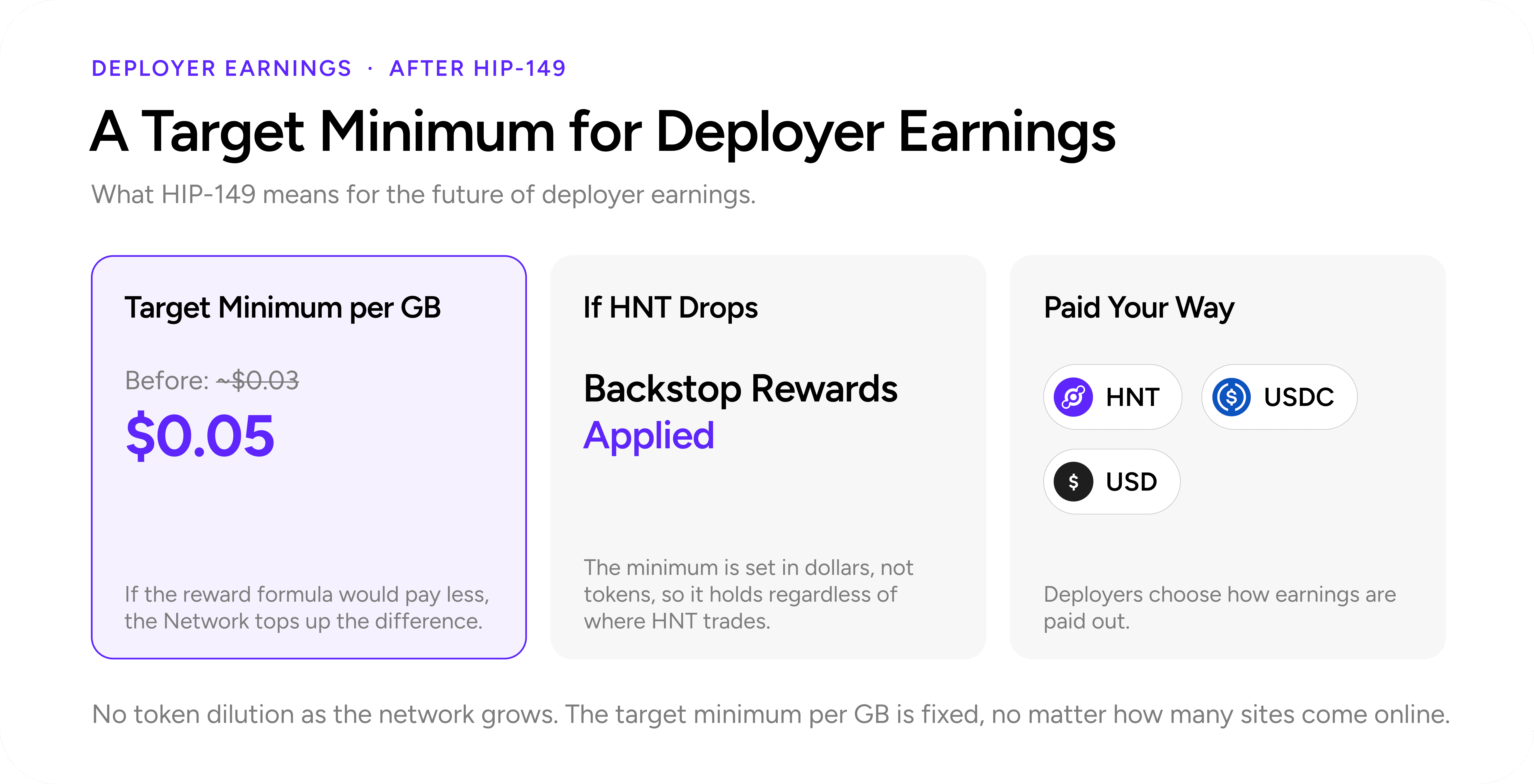
Hoy en día, según las tarifas comerciales actuales, $0.05 es el mínimo objetivo que gana un implementador de Helium por gigabyte de datos que transportan sus sitios, incluso si el precio de HNT baja. Para nuevos lugares y sitios, ese piso convierte la incertidumbre de las ganancias en un número sobre el cual se puede planificar.
Así es como funciona la red de seguridad:
A los implementadores se les paga con las recompensas diarias regulares de la red, lo que significa que el valor en dólares de esas recompensas se mueve con el precio de HNT. Cuando el valor cae por debajo del objetivo de $0.05, el protocolo compensa la diferencia. No genera HNT adicionales, sino que vuelve a emitir una parte del HNT que ya se había quemado para pagar esos mismos datos, por lo que la red de seguridad no añade nada al suministro total. Simplemente recicla lo que la red ya había ganado.
Por el lado positivo, las ganancias suben con el precio de HNT hasta tres veces lo que pagan los Operadores, es decir, $0.30/GB hoy en día. Más allá de eso, el exceso fluye hacia los stakers a largo plazo de la red. Las ganancias se mantienen alineadas con los ingresos de los Operadores, y eso es lo que hace que los ingresos por despliegue sean algo que una empresa realmente pueda respaldar, con ambos extremos del rango aumentando a medida que mejoran las tarifas comerciales.
Algunas cosas que vale la pena saber:
Al precio de HNT al momento de publicar este artículo, este piso ya es lo que mantiene altas las ganancias de los implementadores de Helium. Sin él, las ganancias serían más bajas en este momento.
El mínimo de ganancias es un objetivo, no una garantía blindada. Si el precio de HNT cae rápido, la compensación puede tardar una o dos semanas hasta que haya suficiente HNT recientemente quemado para cubrirlo por completo.
El piso y las matemáticas detrás de él están fuera de la discreción administrativa de cualquiera. Cambiarlos requiere una votación completa de la comunidad de Helium.
Antes de HIP-149, los implementadores ganaban cerca de $0.03 por gigabyte. El protocolo eleva ese mínimo y lo vincula al USD, garantizando la estabilidad sin importar dónde cotice el HNT. En otras redes de descarga, las ganancias se diluyen a medida que la red crece: más participantes dividiéndose el mismo pastel significa que la parte de cada implementador se reduce con el tiempo. El piso de Helium funciona al revés, manteniendo el mínimo estable por gigabyte sin importar qué tan grande se vuelva la red. Como recordatorio, los implementadores de Helium Plus eligen cómo se les paga: HNT, USDC o USD.
En resumen, HIP-149 añade una importante red de seguridad a la tasa de ganancias para los socios locales y los implementadores de la red Helium para garantizar la estabilidad de la cobertura y una economía más sólida para las personas que construyen esta red.
Para obtener más información sobre cómo incorporar establecimientos a la red Helium, envíe un correo electrónico al equipo a business@helium.com.